



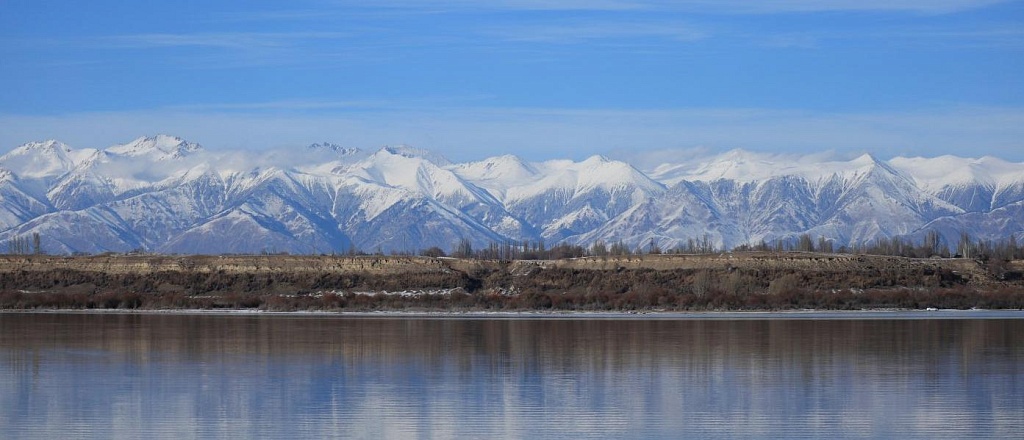

Issyk-Kul is the second largest high-altitude lake in the world after Lake Titicaca. Set at 1607 meters above sea level, it never freezes and stays deep blue even on overcast days. Spring is the best time to visit if you want to explore gorges, waterfalls, and hot springs without the summer crowds. The beach season hasn’t started yet, but the mountains are already accessible, the air is crisp, and prices are lower. Here are 13 places, from glacial lakes to a Dungan mosque, that make the trip memorable.
Ala-Kul Lake
A glacial lake at 3600 meters with a depth of 70 meters, Ala-Kul is one of the most photographed spots in the region. Its water shifts between turquoise and green, framed by snow-covered peaks and rocky slopes. The usual route runs through Jeti-Oguz Gorge: you can drive to a base camp and then hike with a guide — the ascent takes around four to five hours. In spring, the trail opens earlier than many expect, but sturdy footwear and readiness for sudden weather changes are essential.
Tears of the Snow Leopard
One of the most accessible waterfalls in the region. The hike from the parking area in Karakol Gorge takes about an hour each way. In spring, when the snow melts, the water flow is especially powerful, and the trail is surrounded by dense coniferous forest. It pairs well with a visit to Arashan, as both are located in the same gorge.
Altyn-Arashan Hot Spring
A thermal spring complex about 20 kilometers from Karakol. The hottest pools reach up to 50°C, with radon-rich water. You can get there by jeep along a rough road or hike for three to four hours — the latter is a popular day trip. The springs are open year-round and are especially rewarding after trekking to Ala-Kul.
Jilisu Hot Spring
A sulfur-rich hot spring with water temperatures around 40°C, located just a few minutes’ walk from the main Arashan complex. Less known than nearby pools and often less crowded. Ideal to combine with an overnight stay in a guesthouse in Arashan.
Juuku Hot Spring
Located on the southern shore, these springs are slightly cooler at around 34°C, making them suitable for longer soaks. Accessible by car via a dirt road. Nearby are simple guesthouses and cafés, making it a convenient base for exploring the southern coastline.
Chon-Kemin Cable Car
A cable car in the Chon-Kemin Valley lifts visitors to a viewpoint overlooking the valley, with the lake visible in the distance. It’s about 20 kilometers from the village of the same name and operates in spring from 09:00 to 18:00. Best combined with a walk through the valley — one of the most scenic gorges on the northern shore.
Fishing Villages of the Northern Shore
Small settlements stretch along the northern shore between Balykchy and Ton District. In some fishing households, you can arrange to buy fresh fish straight from the boat — most commonly chebak and carp. In spring, the villages feel especially lively as locals prepare for the season and fishing nets dry along the shore.
Ton and Balykchy
Balykchy is the western gateway to Issyk-Kul, a small town with a market and waterfront where the road around the lake begins. Ton is a quiet settlement on the southeastern shore with sweeping mountain views. Neither sees many tourists, but both offer a glimpse into local life — markets, teahouses, and Soviet-era houses.
Tulip Fields in Chon-Aral
In spring, wild tulips bloom around Karakol and in Chon-Aral, about 15 kilometers from the city. You can reach the fields by bicycle or car, and entry is free. Peak bloom is usually in April, though timing depends on the weather. Mornings are best for softer light and fewer visitors.
Jeti-Oguz Gorge
Seven striking red rock formations dominate this southern shore landmark. The name translates as “Seven Bulls”, as the rocks resemble the backs of massive animals. The gorge begins just beyond the village of the same name, about 30 kilometers from Karakol. While crowded in summer, spring offers a much quieter experience. Trails are well marked, and horseback routes are available.
Skazka Canyon
Also known as Fairy Tale Canyon, this is one of Kyrgyzstan’s most photographed landscapes. Sandstone formations in shades of red, orange, and beige resemble Martian terrain. Located about 20 minutes from the southern shore, entry is free. The best time to visit is in the morning, when the angled light brings out the colors.
Dungan Mosque in Karakol
One of only two historic Dungan pagoda-style mosques in the former Soviet Union — the other is in Zharkent. Built in the 19th century by Dungans — Chinese Muslims — it was constructed without a single nail. The cornices are decorated with figures from Chinese mythology: dragons, lions, and phoenixes. The blend of Islamic architecture and East Asian design is rare and striking. Located in central Karakol, entry is free.
Petroglyphs in Cholpon-Ata
An open-air museum on the northern shore featuring thousands of rock carvings dating from the Bronze Age to the Middle Ages — depicting goats, deer, hunters, and solar symbols. Located within Cholpon-Ata, with paid entry. In spring, the cooler weather makes walking across the rocky terrain much more comfortable. Nearby is the Rukh Ordo Cultural Center, an ethnocultural site on the lakeshore with mountain views.