



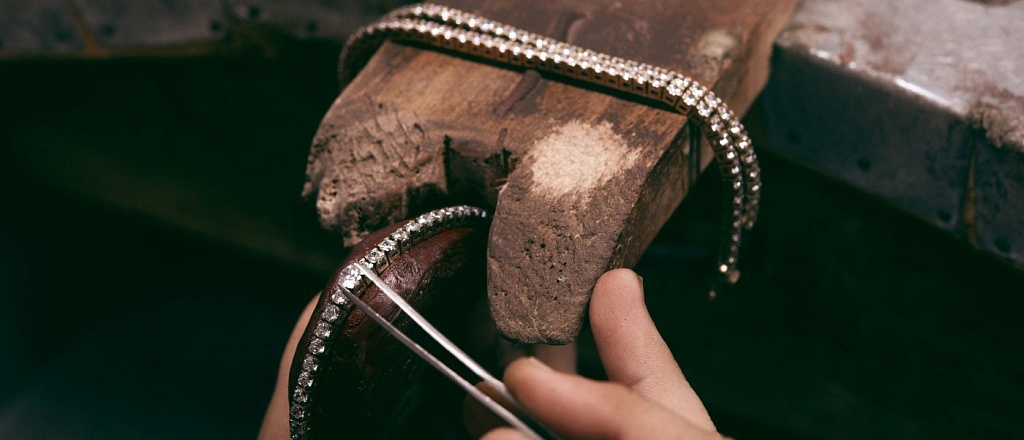

Founded by the Persian king Cyrus, destroyed by Alexander the Great, and renamed twice over the past 25 years, Istaravshan has nevertheless preserved more than 150 traditional crafts. Located in northern Tajikistan, it is a city where jewelry making remains a living tradition practiced by generations of artisans rather than displayed behind museum glass.
A City with Three Names
Istaravshan is located in Tajikistan’s Sughd Region, at the foothills of the Turkestan Range, 78 kilometers from Khujand and approximately 1000 meters above sea level. The city was founded in the 6th century BCE by the Persian king Cyrus of the Achaemenid dynasty, who ordered the settlement to be fortified with three defensive walls and a citadel. The Greeks called it Cyropolis, while in Persian tradition it was known as Kurushkada. By the 4th century BCE, when Alexander the Great conquered Central Asia, Kurushkada had already become a major fortified city.
During the Middle Ages, Istaravshan experienced two periods of prosperity: first under the Samanid dynasty in the 9th and 10th centuries, and later under the Timurids in the 14th century. During the Soviet era and until 2000, the city was known as Ura-Tyube. In 2002, it celebrated its 2500th anniversary.
150 Traditional Crafts
In October 2024, Istaravshan officially received the title of "World Crafts City" from the World Crafts Council, an international organization affiliated with UNESCO. The decision was made during the first International Crafts Festival "Ozar", where all 20 council members from 14 countries voted unanimously in favor of the designation. More than 250 artisans from 19 countries participated in the festival.
Today, the city is home to over 150 traditional crafts. Local artisans specialize in wood carving, ganch plaster carving, pottery, blacksmithing, metal tinning, carpet weaving, knife making, and gold embroidery. Some of these crafts have nearly disappeared elsewhere, making Istaravshan one of the few places where they continue to thrive. One example is chitgari — the traditional technique of printing patterns on fabric using hand-carved wooden blocks.
Silver — The City’s Signature Craft
Jewelry making holds a special place in Istaravshan. Historically, local artisans were known as "zargar", a title of honor attached to their names. Among the city’s renowned jewelers of past centuries were Mullo Otaboy Mirboki Zargar and Mullo Khudoyori Istaravshani.
Silver is more than a material here — it is a cultural symbol. According to tradition, a newborn girl’s first gift is a pair of small silver earrings, known as "tuhfai qiemati", a lifelong gift from her parents. Silver is also believed to serve as a protective talisman against the evil eye.
Local artisans continue to use techniques refined over centuries, including niello work, granulation, engraving, forging, stamping, and gemstone polishing. Their designs feature geometric patterns inspired by "islimi" and "girih" motifs, hallmarks of Tajik decorative arts. Every piece is crafted entirely by hand, from melting and shaping the silver to the final polish.
What to See
Istaravshan is home to seven nationally significant monuments, 14 architectural landmarks of local importance, and 59 archaeological sites. Key attractions include the Mugteppa settlement dating from the 2nd to 7th centuries, the Kah-Kaha Fortress, the Hazrati Shoh complex with its mausoleum and mosque, and the Sari Mazor ensemble.
The city’s most prominent landmark is the "Kok Gumbaz", or "Blue Dome", mosque-madrasa. Built in the 16th century under Sultan Abdullatif, it served as the city’s main Friday mosque. Its dome collapsed in the late 19th century but was later restored by local craftsmen using traditional techniques. The building’s decoration combines intricate ornamentation with calligraphy. Sultan Abdullatif himself was the son of the renowned scholar and astronomer Ulugbek.
The narrow streets of the old town, lined with adobe houses and carved wooden gates, preserve the atmosphere of a medieval Central Asian settlement. Dozens of small workshops still operate here today.
Where to Find the Artisans
Visitors can meet Istaravshan’s silversmiths in the workshops and stalls of the old bazaar, where artisan trading rows continue to operate year round.
One local jeweler can be found online at @gold_istaravshan.
The workshop offers handcrafted jewelry, including rings, bracelets, earrings, and decorative pieces inspired by traditional Tajik design.